
Restoring Condenser Vacuum Through CIP of Cooling-Water Tubes: A Whey Industry Case Study
- Posted on 26th August 2026
- in Articles, Condensor, Other
- by Jan de Geest
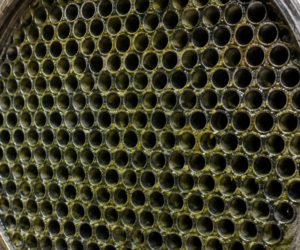 In whey permeate and whey processing, condenser performance directly affects process efficiency and product quality. When heat-transfer performance declines, the system vacuum deteriorates, condensation temperature rises, and the process begins to destabilize.
At one of the world’s largest whey producers, this gradual loss of condenser performance began affecting a two-stage flash cooler. The higher operating temperature negatively impacted lactose crystallization, the primary purpose of the flash cooling system.
This loss of lactose crystal generation in the flash cooling system impacted the downstream crystallization process, resulting in poor lactose crystal yields. With high levels of uncrystallized lactose, too much amorphous lactose was being fed into the dryer, resulting in significant fouling of the drying system.
The investigation ultimately revealed an unexpected cause: severe algae fouling inside the condenser’s cooling-water tubes.
The Challenge
Over time, the flash cooler gradually lost vacuum, accompanied by rising condensation temperature. As the condition worsened, the higher operating temperature began affecting lactose crystallization.
The condenser was eventually opened for inspection, revealing heavy algae fouling inside the cooling-water tubes. The biological growth had created significant resistance to heat transfer and impaired the condenser’s ability to remove heat effectively.
The cooling-water side had become the limiting factor in achieving the required condenser performance.
The CIP Solution
Because the fouling was inside the tubes, flushing with cooling water was not sufficient.
A mobile CIP skid equipped with a circulation pump and heating element was connected to the condenser using the existing drain connections. The cleaning process consisted of two stages:
Caustic cleaning removed the organic fouling, including algae and associated biological material.
Acid cleaning followed to remove calcium and other mineral deposits that had accumulated inside the tubes.
However, the cleaning chemistry was only part of the solution.
The Key: Flow Velocity and Temperature
For effective CIP of heat-exchanger tubes, sufficient flow velocity is essential. The cleaning solution needs to generate enough turbulence and shear to remove deposits from the tube walls.
In this application, we targeted a tube velocity of approximately 4–6 ft/s. Depending on tube diameter and condenser design, achieving this velocity can require substantially more flow than the normal cooling-water operating flow.
The CIP skid’s heating element was used to bring the cleaning solution to the appropriate temperature, further improving cleaning effectiveness.
Effective CIP requires the right combination of chemistry, flow velocity, temperature, and circulation time.
The Result
The improved CIP process worked very well. The heavy biological fouling and associated mineral deposits were removed successfully from the cooling-water tubes.
After the condenser was returned to operation, heat-transfer performance and vacuum conditions improved, allowing the flash cooler to return to its intended operating conditions and restore the temperature control required for effective lactose crystallization.
What initially appeared to be a vacuum-system problem was ultimately traced to fouling on the cooling-water side of the condenser.
Designing for Fouling Prevention and CIP
While CIP can restore condenser performance, preventing fouling in the first place is even better.
Proper condenser design, including appropriate tube sizing, cooling-water velocity, flow distribution, materials of construction, and accessibility for cleaning, can help minimize the risk of fouling and simplify future maintenance.
Cooling water treatment is equally important. The appropriate water-treatment additives and proper water chemistry can help minimize calcium scale and control biological growth such as algae.
When CIP is required, the cooling-water circuit should also be designed to accommodate it. Where possible, we recommend adequately sized CIP connections at both the inlet and outlet of the condenser to allow the high flow rates needed to achieve the desired tube velocity.
The cooling-water supply and return lines to the cooling tower should also be isolable. This allows the condenser to be treated as a controlled CIP circuit without exposing other components to the cleaning chemicals.
The section being cleaned must be compatible with the selected chemicals, so always evaluate materials of construction before introducing caustic or acid solutions.
Lessons Learned
Do not overlook cooling-water fouling when investigating declining condenser performance. When vacuum deteriorates, or condensation temperature rises, the cause may not be on the process side. Fouling inside the cooling-water tubes can progressively reduce heat transfer until the condenser can no longer achieve its intended conditions.
In this case, appropriate cleaning chemistry, controlled CIP temperature, sufficient circulation, and a target tube velocity of 4–6 ft/s successfully restored condenser performance.
Just as importantly, the experience reinforced the value of proper condenser design and effective cooling-water treatment to minimize the risk of calcium fouling and biological growth.
When condenser performance is critical to vacuum, temperature control, or crystallization, proper design, cooling-water treatment, and an effective CIP strategy all play an important role in maintaining reliable process performance.
If condenser fouling is affecting your process performance, the right CIP strategy can make all the difference. Contact us to discuss your condenser challenges and how we can help restore performance and improve reliability.

“Our goal is to give you the best evaporator and dryer process balanced between capital investment and operating expenses with the highest product quality. This way you can differentiate yourself in your market with either commodity products or special niche products.”
- Restoring Condenser Vacuum Through CIP of Cooling-Water Tubes: A Whey Industry Case Study - August 26, 2026
- The Gentle Power of Steam Infusion: Protecting Product Integrity in Thermal Processing - August 19, 2026
- Internal Product Feedlines in Falling Film Evaporators: A Hidden Source of Fouling in Dairy Applications - July 17, 2026
Tags: biological fouling, CIP, condensate, Condenser, Condensor, Crystallization, Flash Cooling, fouling, Heat Transfer, Lactose, mineral deposits, process, vacuum, Whey