
Internal Product Feedlines in Falling Film Evaporators: A Hidden Source of Fouling in Dairy Applications
- Posted on 17th July 2026
- in Articles, Falling Film Evaporators
- by Jan de Geest
Introduction
When discussing falling-film evaporator performance, most attention is typically directed toward heat-transfer coefficients, vapor recompression efficiency, or separator design. However, one often-overlooked area that can significantly impact operational reliability is the product distribution system at the top of the evaporator.
Over the years, GLM has evaluated and optimized numerous evaporator installations processing a variety of dairy products, such as skim milk, whey concentrates, milk protein concentrates, and infant formula. One recurring challenge has been persistent fouling that is associated with internal product feedline designs that isolate the evaporator passes.
While these systems are intended to ensure proper product distribution, they can unintentionally create localized hot spots that accelerate protein deposition and significantly increase cleaning requirements. Too often, manual cleaning is required to remove this protein fouling.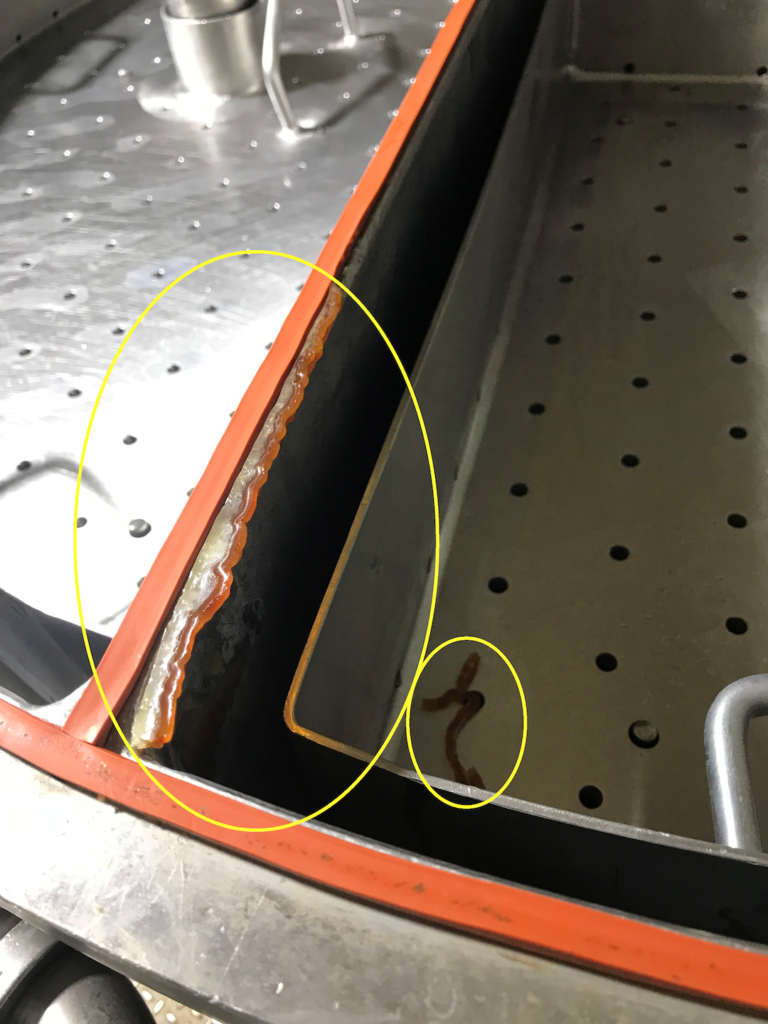
The Purpose of Internal Product Feedlines
Falling-film evaporators with internal product feedlines use them to distribute product to individual passes. Since these feedlines feed from below rather than from above, there is a need to prevent product from carrying over from one pass to the next,and these designs often incorporate vertical divider plates that isolate and seal each evaporator pass from the others to prevent mixing.
At first glance, this appears to be an effective method of ensuring uniform product flow. However, the system’s thermal behavior under operating conditions can lead to unintended consequences.
The Challenge: Flash Vapor and Localized Heating
In vacuum evaporation applications, the incoming product often enters the first pass at a temperature above the boiling point at the pressure inside the effect. For example, if the product is coming from an upstream product pasteurizer or an upstream evaporator effect, it is often at a higher temperature than the boiling temperature in the effect it is entering.
As the product enters the distributor, a portion of its sensible heat is immediately released as flash vapor. This rapid flashing generates a release of vapor pressure and a resulting vapor temperature rise above the distribution pan.
Why Protein Products Are Particularly Sensitive
Small droplets and splashes naturally present within the distributor section can contact the overheated divider surfaces. When this occurs, proteins begin to denature and adhere to the metal surface. Over time, these deposits continue to accumulate, forming increasingly thick layers of baked-on product.
The consequences often include:
- Accelerated fouling rates
- Bacteriological issues, potentially leading to product quality concerns
- More difficult Cleaning-in-Place (CIP) cycles
- Increased chemical and water consumption
- Manual intervention for cleaning as the evaporator heads must be opened up and manually cleaned to remove the buildup
In many cases, these deposits become some of the most difficult areas of the evaporator to clean effectively.
The Compounding Effect
Once an initial protein layer develops, the problem tends to worsen.
Elimination of Localized Hot Spots
The fouling layer acts as an insulating surface that traps additional product and creates rougher surface conditions. This promotes further product accumulation and can eventually lead to substantial deposits on the divider walls.
Operators often observe that these areas require longer CIP cycles and may even require frequent manual cleaning to fully remove the buildup.
An Alternative Approach: Open Top-Down Product Distribution
An alternative distributor design utilizes an open top-down product inlet arrangement.
Rather than compartmentalizing each pass with divider walls extending into the vapor space, the distributor remains open across the top of the evaporator. Product is distributed downward into the appropriate tube bundles while maintaining a common vapor space above.
This configuration offers several advantages:
Because there is no compartment walls exposed directly to product flash energy, the risk of causing overheated surfaces is significantly reduced.
Uniform Vapor Distribution
The open vapor space allows flash vapor generated from the incoming feed to disperse freely throughout the entire top section of the effect. Instead of being concentrated near a divider, the energy is distributed more uniformly.
Reduced Protein Fouling
With fewer localized hot surfaces, the opportunity for protein droplets to bake onto metal surfaces is greatly diminished.
Improved Cleanability
The open design eliminates many of the difficult-to-clean surfaces commonly associated with compartment dividers, resulting in more effective CIP performance and reduced cleaning times.
Long-Term Operational Benefits
Although distributor design may seem like a minor detail compared to the overall evaporator system, its impact on operational performance is substantial.
Facilities processing protein-rich dairy products can realize benefits, including:
- Longer production campaigns between CIP cycles
- Reduced fouling rates
- Improved evaporator availability
- Lower cleaning costs
- Reduced maintenance requirements
- Reducing the risk of bacteriological issues
For high-protein dairy applications, careful attention to distributor design can be the difference between an evaporator that operates reliably for extended periods and one that experiences recurring fouling challenges.
Conclusion
The distributor section and the product feed lines into the evaporator passes are the first point of contact between the incoming product and the evaporator, making them among the most critical areas for both product quality and equipment performance.
Experience has shown that compartmentalized internal feedline systems can create localized hot spots due to flash vapor generated in the first pass. In dairy applications, these hot surfaces often become focal points for protein deposition and fouling.
Open-top-down distribution designs avoid these issues by allowing flash vapor to distribute naturally across the evaporator while eliminating overheated divider surfaces that promote protein bake-on. The result is a cleaner, more reliable evaporator better suited to demanding dairy applications.
When evaluating evaporator performance, distributor design should not be overlooked. In many cases, it is one of the most important factors influencing long-term operational success. Contact us for more information if your installation has these or any other issues.

“Our goal is to give you the best evaporator and dryer process balanced between capital investment and operating expenses with the highest product quality. This way you can differentiate yourself in your market with either commodity products or special niche products.”
- Restoring Condenser Vacuum Through CIP of Cooling-Water Tubes: A Whey Industry Case Study - August 26, 2026
- The Gentle Power of Steam Infusion: Protecting Product Integrity in Thermal Processing - August 19, 2026
- Internal Product Feedlines in Falling Film Evaporators: A Hidden Source of Fouling in Dairy Applications - July 17, 2026
Tags: Bacterial Growth, Dairy, distribution pan, evaporator, falling film, Falling Film Evaporator, fouling, GLM Hydro, Protein